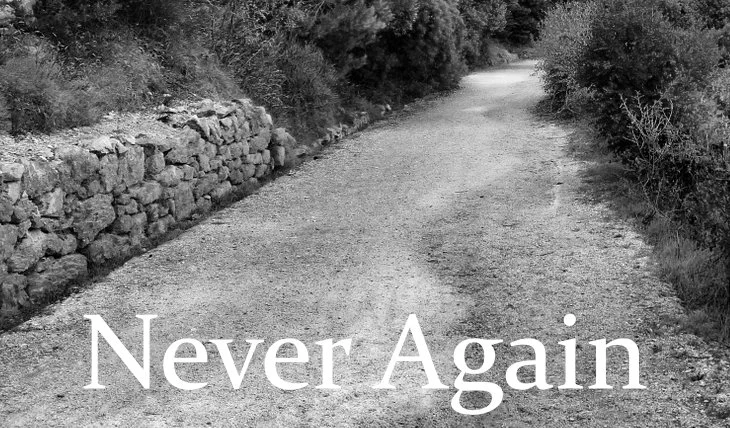
© Matthew L. Jones
As they parted, he said these words to her: Never again without you, my love.
She smiled at him, but tears were near. She never got used to the aching pull of their parting, no matter how many times the Four Winds took him. She could feel it already, a small fist in her chest. Before their final embrace broke, the fist had grown to a stone. She knew that tonight, when she reached for his warmth in the dark and there was none, the stone would become a boulder and the crushing reality of his absence would land squarely upon her, stealing her breath. Every first night. Every time.
If his many long journeys had taught her anything, it was that she would eventually come to accept his absence. But she also knew that tonight, on that first lonely night, the realization he was gone would also come with the fear he would never return. There in the dark, gasping and alone, panic always swallowed her.
Was this really only the first night? Or is there something hidden in the darkness her mind will not let her accept? Did she just dream she said goodbye as they had done countless times before? Or in reality, did she bury him today? Is this how grief begins without him? Forever without him?
NO! She would realize. NO…her mind clearing. No.
Every first night was like this. Breathless. Cold yet impossibly hot. Sweating in the night. But she suspected this first night would be different—even as his shape became distant, the smell of him faded from the air around her, and the sun followed him over the hills.
She had six words more powerful than any cold. Every darkness.
His promise: Never again without you, my love.
He always left her with beautiful words. Words of comfort. Words of love. But to say they would never again part? He never said that before. But that day he did. That day he promised. That day he avowed it to her and to any gods who would listen. There was something different in those words, and she had never believed anything he said with more certainty. It felt as if he had committed to eternity anew, as if he had asked to be her husband all over again.
She found it hard to believe that he spoke that promise nearly two years ago, yet the words still rang in her ears as fresh as yesterday.
A miracle, she often thought: Why is it that when we lose someone—or when we are just away from them for too long, she corrected herself—that our senses slowly forget them? I can no longer see him. I cannot smell him. I cannot taste his salt or feel his hand on mine.
She marveled at how the memory of each sense decays differently, like petals dying from a flower. Each dropping away in their own time and order. Except for the sound of his voice. And those words. But they had never been apart this long, and she secretly feared that even the sound of his voice would one day abandon her.
“Never again without you, my love…” she whispered to the rising sun each day, breathing in the salty air and exhaling her prayer to the Four Winds, hoping somehow her words would drift to him.
While the nights without him were hardest at first, she learned to cope with them. To look forward to them, even. Because at night there were moments of deep disconnection, where not even dreams could find her. A place where time passed instantly. Blessed oblivion.
Now it was mornings that pained her most. Especially market day. When he was there, market days always began with the smell of distant cook fires stirring them awake well before the cock’s crow could. There was subtle nuzzling. Tender caresses. Gentle whispers masquerading as words spoken so close to her ear that the breeze of his breath raised silken hackles at the nape of her neck. She would turn to him, and they would fall together as the golden light of day crept softly into the room.
Afterward they would stroll arm in arm to market, weaving down sea-misted alleyways to avoid the crush and bustle of others until the last possible moment, allowing themselves to believe that the city, the streets, and the world around them was theirs alone. As they neared the main thoroughfare, shutters and stalls would clatter to life. Hawkers cleared their throats, spat, and warmed their voices in a cacophony of crescendo and vibrato.
Their first stop was usually the wine shop of Arrius Crescens—a round and red-faced man as full of good cheer as he was, usually, of wine. Their families had done business for generations, and Arrius always promised that one day he would steal her away from her husband. It was a familiar jest they all enjoyed in good faith, and she expected nothing less from a man claiming to be descended of Bacchus himself.
From there they allowed themselves to be swept along with the crowd until they reached the bright-marbled expanse of The Forum, where they would break their fast on fruits and cheeses and warm bread dipped in watered wine. They would catch up on the latest news and gossip at the fountain. And ponder the countless orators, philosophers, and politicians who competed for attention among the musicians, magicians, and jugglers who ringed the market square.
Today as she walked the streets alone reminiscing, she felt a special sadness for the thousands of everyday moments he would forever miss. Small things. Insignificant, even. Like the day the fishmonger had the sweetest mussels. Or when the baker, still full of wine from the night before, burned the day’s loaves to a cinder. Or how The Mountain had seemed displeased of late, billowing and bellowing more boldly. He would know why. Or pretend to. They would discuss which godly disagreements may be the cause, or what friction between heaven and earth might be behind it.
What she most wanted to share with him was how the earth shook more often, and with increasing vigor. How one day the ground quaked so violently jars fell from the shelves, shattering a month’s worth of honey in an instant.
The Oracle warned of trouble. But then they always do. There is more profit in prophesies of pain than in those of prosperity. The threat of despair is always good for business.
But for now the mountain was quiet, she was home, and night had begun to fall. She noticed the lights of the other houses seemed more distant. As if a dense fog had slipped in from the sea—a creeping closeness intent on obscuring and isolating all at once. Later that night she stood on her terrace looking at a squid-ink sky. The air felt thick and electric. There was no moon, and even the stars refused to shine. The lights from the other houses were gone now, too. Blackened.
It was late summer, which meant the shifting winds and tides would soon bring her beloved back to her. But tonight, standing there in the darkness, she felt every moment of his long absence. And she felt very much alone. As she turned to retire to her bedchamber the earth rumbled beneath her, causing her to grasp the low terrace wall. She heard a heavy crash in the distance, and a tinkling—the shattering and scattering of marble. There were raised voices, muffled and far away. She wanted to grab an oil lamp and follow that sound. That is what he would have done, and she with him. But alone? Not on this black night.
She decided instead to go to her bed and await the kiss of Hypnos, hoping that sleep would once again deliver escape. She did not linger long in slumber, it seemed, before the sounds of shouting roused her—a voice calling her name from outside. As she ran to the shutters, the veil of sleep allowed her to believe, for a moment, that her love had returned. She was disappointed to discover Arrius the Wine Merchant in the street below instead. She was equally disappointed to discover that morning had not yet broken. The sky was still dark, as if dawn were hours away.
“Come, you must leave with me!” the round man shouted from the cobbles.
“Arrius! This is no time for your games,” she admonished him, “Can you not wait for the sun joins us?”
“But my dear the sun is up. It is morning already and the city is emptying!” he said.
She had a hard time believing this given the dark sky above her. Yet Arrius did not appear to be his normal self in that he was very clearly sober. A rare sight indeed. His cheery demeanor had been replaced by a swelling sense of urgency.
“The Mountain. It is enraged. And we are in its path.” Arrius replied.
“You speak nonsense. How can we be in the path of a thing that cannot move? The Mountain has been angry before and it will be again. Now go along your way. My beloved will return in a few days’ time if Neptune wills it. And I have much to do!”
Despite his continued pleas she turns and strides back inside, closing the shuttered doors behind her to mute the persistent Arrius. It took a very long time—and another great rumble of the earth—before Arrius finally faded away.
Knowing that the wine merchant is gone, she ventures back onto the terrace. It was indeed morning, Arrius was true in that. But the day was grey and lifeless. The evening’s fog had survived sunrise. Thickened, even. Like barley porridge left overnight in a copper pot. The air was as much smoke as it was fog—a stagnant stillness that drove the sun high into the heavens, too high to lend much warmth or light to the city below. The streets around her home were quiet. Yet the sounds and signs of commotion echoed in the near distance. Rather than risk a walk to the nearest tavern, she decided to take her morning meal at home, making do with last night’s crusted bread, a pot of honey, salty-hard cheese, and a handful of nuts and dried fruit.
Near what she figured to be mid-day there was a deafening crack that sounded as if The Mountain itself had fractured. Soon after, the earth began to shake again—only this time it did not stop. She heard the thudding whomp of large stones crashing to the street. Voices were again raised, though they were fewer and farther off.
She thought of Arrius and his panicked insistence. How he pleaded for her to leave. And how she had dismissed him outright. Should she have gone with him? She would go to his shop and see if he was still there. Just to be sure.
With the ground still rolling, she throws a cloak around her shoulders and stumbles outside to a world she no longer knew. The once neat streets were choked with debris—shattered stone, crumbled columns, fallen facades—all thrown to ruin. Like a cherished plaything a child had grown tired of and in a tantrum, demolished. Coin-sized pebbles of pumice fell from the sky like rain, making any progress difficult and painful. The overhangs she would normally seek shelter beneath on rainy days were of little help, many having collapsed. The grand villas that once crowned the end of her street had fallen inward, burying the lane—and with it all hope of reaching Arrius and his shop. If, in fact, either still existed.
The air around her is dense and hot. Each gasping inhale brings with it a breath of fire, each choking exhale a taste of ash. She gathers her cloak to her mouth and nose to fend off the fumes and the dust and the smoke. Her mind begins to cloud, her senses dim. She cannot move forward and has no choice but to turn back. To return to the only place she knows in this madness. Home.
Frightened and alone, she stumbles and gasps in the thickening air. Confused and disoriented. All of the comforts she knew so well—the textile shops, the food stalls, every bit and piece of the life she loved—are cracking and crumbling around her. She manages to weave her way to the small courtyard in front of her modest home before collapsing just within reach of her front door. It was only a matter of feet, but it may as well have been miles. She can go no further, and darkness takes her.
She lay in the courtyard for what could have been a minute or an eternity. Time did not exist. Not anymore, not to her. Not until she felt a hand upon her, firm and familiar. The sound of her name penetrates the fog around her.
“Is it you?” she chokes in the dimming grey. “I cannot tell who holds my senses, Thanatos or Hypnos.”
“They are both here. Sleep and Death,” the voice says to her. His voice. “The twins ride Vulcan’s rage through the streets of Pompeii. The city is theirs now.”
“You saw them? You know this?”
“Yes, my love.” he says as he kneels to her. “The Mountain has broken and will soon swallow the town.”
“And still you came?”
A distant rumble grows louder.
“Yes.”
“Then we will leave here together?”
“No, my love.”
His words make her heart drop.
“Answer me true. Could you have been spared? If you had not come to me?”
He pauses. A precious moment in the few that remained. He had never lied to her, and this would not be his first.
“Yes, my love”
“Then why…” her eyes began to dim.
“Because I promised.” he says as he lays beside her.
Their arms reach out and at last find each other after so long, so much longing. He gently gathers her head to his breast. There at the end of it all, as fire and ash rain down, he speaks his final words so close to her ears it raises the silken hackles at the nape of her neck.
“Never again without you, my love.”
A hot blanket of silence sweeps over them, burying them where they lay—extinguishing and enshrining them at once.
Together.
His promise forever kept.
 Matt Jones | Writer